
A JOURNEY TO MEL PROFESSIONAL – FOUNDING MEMBER’S TESTIMONY
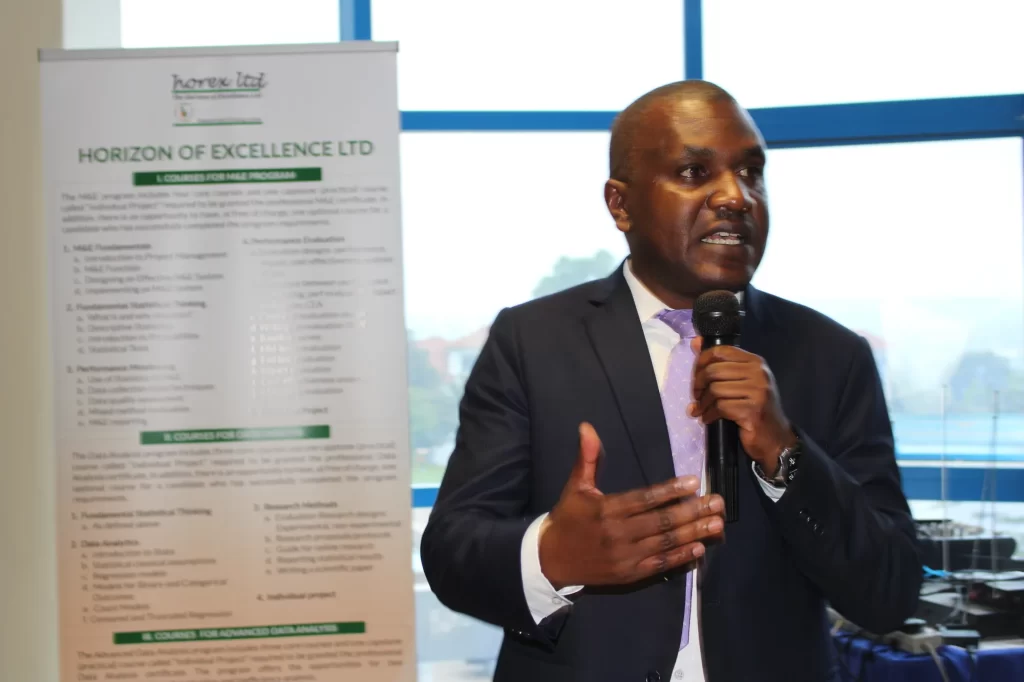
It is my privilege to share with you my journey to becoming a Monitoring, Evaluation, and Learning (MEL) Professional and the founding member of the Horizon of Excellence.
My journey started in 2008 when I dropped the professional studies in Association of Chartered Certified Accountants (ACCA). It was six years after completing my undergraduate studies in Economics/Development studies. In June 2008 I had completed nine out of 14 modules of ACCA. When browsing through internet I suddenly found a resource that was talking about doing impact evaluation and was interested to read it. I was pleased to read that, the determination of whether the impact of an intervention has happened or not is subject to confounding bias and that one needs to use more robust impact evaluation designs to reduce confounding effects to be able to attribute the actual impact to the program. My internet search found out that randomization (or randomized control trial) as an experimental impact evaluation design is the golden standard of impact evaluation and that,
in case it is not feasible, quasi-experimental evaluation designs such as propensity score matching, difference in difference, instrumental variables, regression discontinuity can be used. I was curious to know deeply those methods and when I explored them, I was stuck because they were using statistics and econometrics that I could not understand. Meanwhile, my career ambitions had already shifted to become an evaluation expert. This is the time I decided to pursue a higher degree and to discontinue my ACCA studies.
I tried all my means to have an admission on Master’s program in statistics and economics but in vain due to different reasons including the lack of the solid statistical backgrounds that were set as prerequisite. In September 2009, I got an admission to one-year University degree program of “Méthodes Statistiques de Régression en Epidémiologie: enseignement via internet”. This was organized by “Institut de Santé Publique et Développent (ISPED)” of Bordeaux 2 University in France. I successfully completed it in July 2010 at the time I had to move to USA for the Master of Arts in International Economics and Finance at International Business School (IBS) in Brandeis University. I did choose those two programs with a clear objective of enhancing my knowledge and skills in statistics and econometrics to therefore continue my journey. While the university degree program refreshed my mind with the basic statistics, my studies at IBs pushed my quantitative skills to higher level. I used my spare time wisely to search, interact with professors and specially to develop data analysis and paper writing skills. I have kept a number of papers that from time to time I refer to. My time in USA also was an occasion for me to buy key books that I am still consulting; but I regret that I did not have chance to complete the program though I was doing great. In fact, in the course of one year I completed all the core courses and a number of elective courses. On the other side, I was happy to complete all the courses related to my journey to program evaluation expert.
When I was about to come back home, I thought of creating the Horizon of Excellence as a company that would help realize my dreams. After my arrival, I had another idea of building a partnership with the National Institute of Statistics of Rwanda (NISR). However, my request was not favorably considered and the reason was that the NISR could not partner with a private company. And yet, this could have boosted my exposure to evaluation real-life practice.
Before I joined my studies at ISPED I was an unsuccessful candidate to get an admission to Toulouse University for a Master program in Statistics and Econometrics. So, the idea to request the admission again came back in 2011. I remember that, in my request, I outlined my dreams that I had from 2008 as explained earlier. This time, I was retained but was recommended to take a bridge program in Applied Statistics with additional transition two courses: linear algebra and probabilities. The teaching style was to receive materials, read them and interact with the lecturer and classmates in online question and answer (Q&A) sessions. Then, I realized that the two courses were written in matrix notations which I had forgotten. I was therefore struggling hard to be on track with tests, home works, etc. I addressed the issue to the university and they advised me to continue with only DU in Applied statistics. I successfully completed it and was awarded a degree in 2012.
Till then, I had not had a validated Master Degree. This is the reason why I joined a two-year Master of public health program (MPH) in “Méthodes Quantitative et Econométriques pour la Recherche en Santé (MQERS)” that I completed in June 2016. This came after I had initiated a study “Robust Impact Evaluation Experiments in Rwanda” in 2013. Using my own funds, I chose to do it in order to understand practical aspects of designing and conducting an experimental impact evaluation in Rwanda. I had a research permit delivered by NISR to conduct the study. On top of survey over different projects managed by the Government and International NGOs operating in Rwanda, I analyzed the evaluation reports focusing on consultant justifications of the designs and ways they dealt with selection bias. This really gave me confidence of being on track to my vision. The results of the study as well as my MPH thesis “Evaluation de l’Efficacité et Efficience du Système de Santé Rwandais” were published in 2017. Let me take this opportunity to highlight that in choosing my research topics I was very ambitious in two ways. First, the researches were hard to realize considering my knowledge of that time but I had insights about the final products. I will never forget the comment that I received from the head of MQERS program during the process of approving research proposal: “Tu es loin de la Cible”. Fortunately, the following version was successfully approved. Second, in absence of any sponsorship, those researches were financed by myself. In short, I chose them because they were in line with my ambitions of becoming evaluator. Finally, I joined PhD studies in Data Science with Data Mining specialization since 2018 and my researches are centered to building an effective monitoring, evaluation and learning (MEL) systems of a water utility company.
On the professional side, I showed my colleagues and supervisors my interest and capacity to support M&E teams. These initiatives started on volunteer basis but nowadays, other departments express their official requests to benefit from my support. More importantly, in 2013 and 2014 I provided significant support in managing evaluations and since then I have at least one job objective in M&E or program design every year. In addition to attending several meetings and M&E events, I have had a number of professional training opportunities in M&E and GIS analysis supported by my employer organization. I also have the ones that I myself spent my money for. As far as Horizon of Excellence is concerned, I have done a lot in terms of developing capacities of Rwandans through training and consultancy.
In summary, I have had very long journey but there are still things to learn or refresh my mind on. This is the reason why M&E profession should be conceived as a continuous professional development (CPD) program.
Janvier Mwitirehe,
Charter Member of Horizon of Excellence